Abstract

We introduce VideoMDM, a diffusion-based framework that trains 3D human motion priors directly from accurate 2D poses extracted from monocular videos, without any 3D ground truth. A pretrained 2D-to-3D lifter provides approximate 3D pose sequences that serve as a noisy teacher: these are diffused, denoised by the model in 3D, and supervised in 2D by reprojecting the prediction and comparing against accurate keypoints. We show that, under mild assumptions, a depth-weighted 2D reprojection loss is equivalent in expectation to direct 3D supervision, and we adapt standard 3D motion regularizers — velocity consistency and over-parameterized representation alignment — to this 2D setting. Unlike methods that lift 2D to 3D only at inference, VideoMDM learns a coherent 3D motion manifold during training. On HumanML3D it nearly closes the gap to fully 3D-supervised MDM (FID 0.88 vs 0.54); on real video datasets Fit3D and NBA the method learns to generate motions consistently preferred by humans, with strong quantitative results.

0.88
FID on HumanML3D
(vs 0.54 with full 3D supervision)
lower MPJPE than WHAM
on Fit3D
64%
human preference over MAS
on NBA dataset

Method

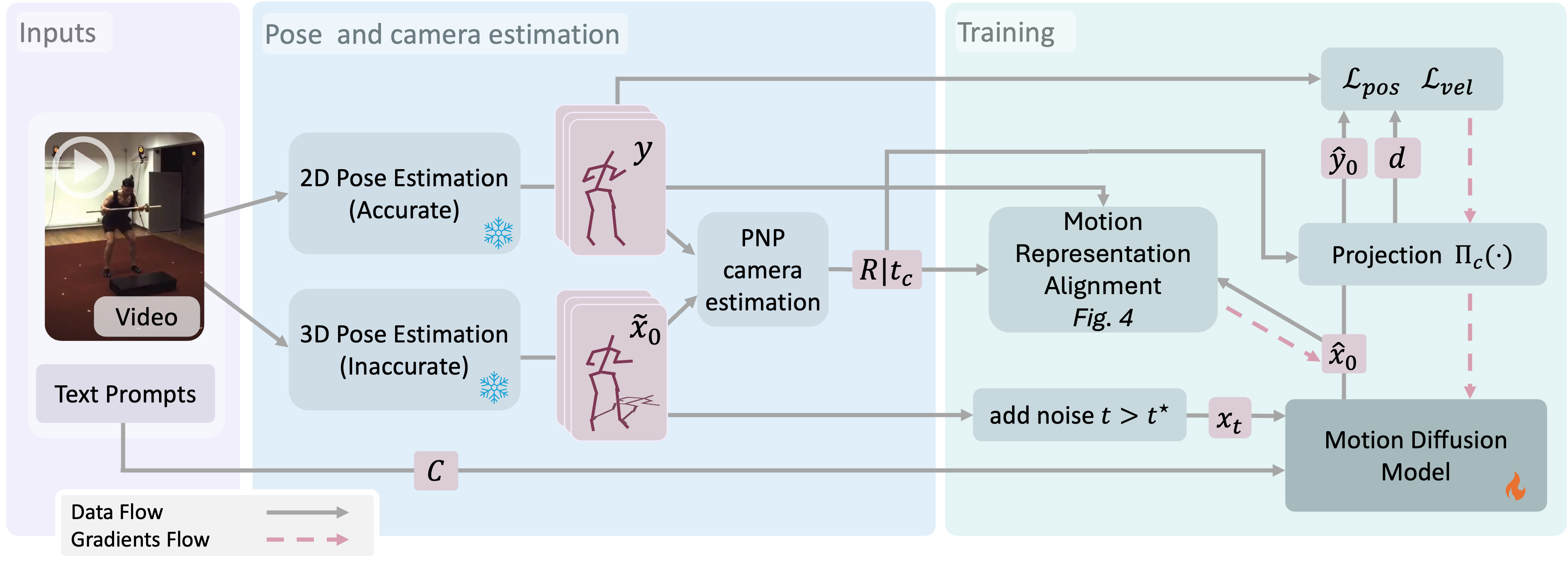
We are given monocular human-motion videos with accurate 2D joint trajectories but no 3D ground truth. A pretrained 2D-to-3D lifter produces approximate 3D pose sequences that serve as a noisy teacher. As in standard diffusion training, we diffuse these lifted 3D estimates and train a denoiser to recover the clean 3D motion — but supervision is applied entirely in 2D by reprojecting the prediction and comparing against the accurate keypoints.

A depth-aware weighting of the reprojection loss is, under mild assumptions, provably equivalent in expectation to direct 3D MSE supervision. We further adapt two standard 3D motion regularizers: a depth-weighted 2D velocity loss for temporal coherence, and a representation alignment loss that supervises the over-parameterized motion channels — joint rotations, velocities, and foot contacts — via ray-projection pseudo-targets derived from the predicted motion and the observed 2D keypoints.
VideoMDM training pipeline
VideoMDM training. From monocular video, we extract accurate 2D keypoints and approximate 3D poses. A motion diffusion model is trained to denoise the 3D poses under multi-source supervision: (i) 3D representation alignment, and (ii) 2D reprojection and velocity consistency with the accurate 2D pose.
Motion Representation Alignment illustration
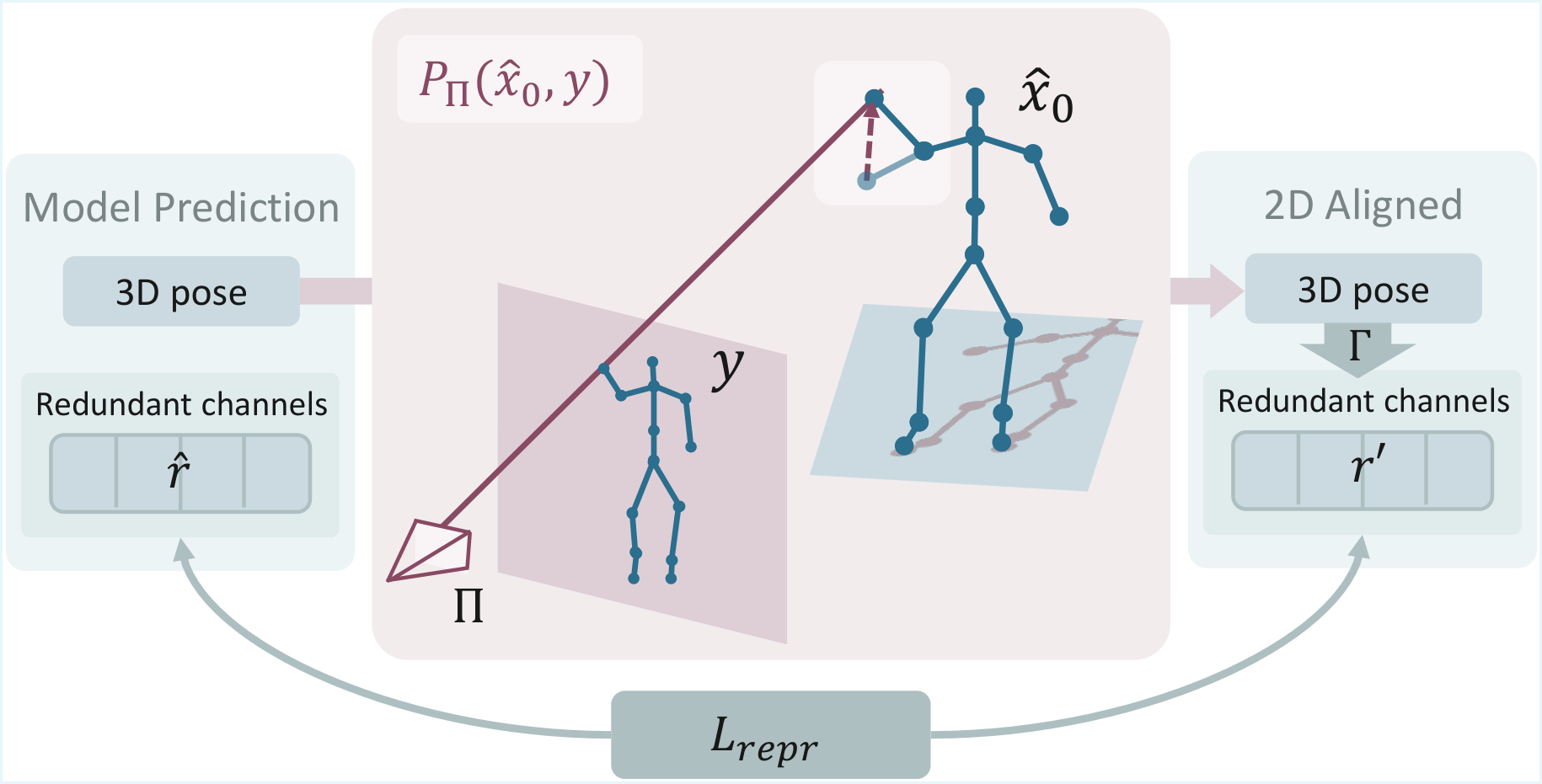
Motion Representation Alignment. Motion generation models commonly adopt an over-parameterized representation that includes joint rotations, velocities, and foot-contact labels alongside joint positions. These redundant channels — derivable from positions — cannot be directly supervised from 2D observations. Each predicted 3D joint is projected to the nearest point on the ray through its observed 2D location, yielding a 2D-consistent pseudo-target from which the redundant channels can be computed and used as supervision.

Text-to-3D Motion from 2D Poses — HumanML3D

To isolate the effect of 2D supervision from pose-estimation noise, we construct a 2D-only version of HumanML3D by projecting MoCap sequences to random cameras and lifting them back with a pretrained lifter. VideoMDM is trained using only these 2D projections and evaluated against the 3D MoCap ground truth.

FID 0.88  ·  3D-supervised MDM achieves 0.54
Prompt MDM on MVLift VideoMDM (Ours)
"a person waves with his right hand."
"the person walks backwards in a straight line."

Generation from Real Fitness Videos — Fit3D

VideoMDM is fine-tuned on Fit3D — real monocular fitness videos with no 3D supervision — using WHAM as the noisy teacher lifter. The fitness exercises (deadlifts, mule kicks, push-ups) are far outside the distribution of any MoCap-based lifter, directly testing the framework's ability to learn motions the teacher has never seen.

Exercise WHAM Lift MDM on WHAM VideoMDM (Ours)
Deadlifts
Diamond push-ups
Barbell dead rows

Citation

@article{mann2026videomdm,
  title  = {VideoMDM: Towards 3D Human Motion Generation From 2D Supervision},
  author = {Mann, Amir and Harari, Gal and Keidar, Merav and Litany, Or},
  year   = {2026}
}